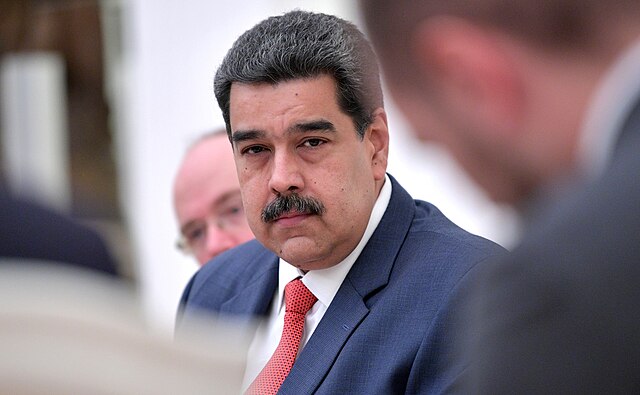
Venezuelan President Nicolás Maduro and his wife, Cilia Flores, are now in U.S. custody in New York, where they are expected to face federal charges, following a U.S. operation that removed them from Venezuela and delivered them directly into American jurisdiction. Their arrival has been publicly confirmed by the President of the United States and the Secretary of Defense, and broadcast video shows the couple disembarking under U.S. control upon landing in New York.
The charges themselves are not new. U.S. prosecutors have accused Maduro for years of leading a narcotics trafficking conspiracy tied to Colombian guerrilla groups and of using the Venezuelan state as a vehicle for drug distribution into the United States. What is new—and unprecedented in the Western Hemisphere in recent decades—is the enforcement mechanism. This was not extradition, negotiation, or regime collapse. It was the physical seizure of a sitting head of state and his transfer to a U.S. courtroom.
Administration officials have framed the operation as a law-enforcement action executed with military assets, a distinction that matters both legally and politically. By bringing Maduro to New York rather than to a military tribunal or offshore facility, the United States is signaling that it intends to prosecute the case through ordinary federal courts, with all the procedural visibility and constraint that entails. The venue—Southern District of New York—places the case squarely within the U.S. criminal justice system, not an ad hoc or exceptional forum.

That choice carries risk. Once before a federal judge, the case becomes governed by rules of evidence, discovery, and due process that Washington does not control unilaterally. Defense counsel will have access to public filings, pretrial motions, and appellate pathways. The administration is effectively betting that the strength of the case outweighs the exposure that comes with transparency.
Internationally, the implications extend well beyond Venezuela. The operation collapses a long-standing distinction between indictment and custody when the defendant is a foreign leader. For years, U.S. indictments against Maduro functioned as political and economic pressure tools. Now they have become executable instruments. Other sanctioned leaders will draw their own conclusions about what protections sovereignty still provides when the United States asserts criminal jurisdiction and is willing to enforce it directly.
Inside Venezuela, the immediate political outcome remains uncertain. Maduro’s removal does not by itself resolve questions of legitimacy, succession, or governance, and no transition framework has been formally recognized. What it does do is force those questions onto an accelerated timeline, both domestically and among regional actors who had grown accustomed to a frozen stalemate.
This moment is not defined by how the operation was conducted but by where it ends: a federal courthouse. The story has moved out of the realm of diplomatic signaling and into the slower, more rigid logic of criminal law. What follows will be shaped less by speeches and sanctions than by arraignments, motions, and sworn testimony—processes that are harder to control, and harder to reverse.