
By American Academy of Orthopaedic Surgeons, Special for USDR
During the summer months, many children are drawn to indoor and outdoor trampolines for fun and physical activity. And yet, trampolines can be extremely dangerous, especially for children under age 6.
In 2015, there were more than 295,000 medically treated trampoline injuries in the U.S., according to the Consumer Product Safety Commission, including 102,943 emergency department visits.

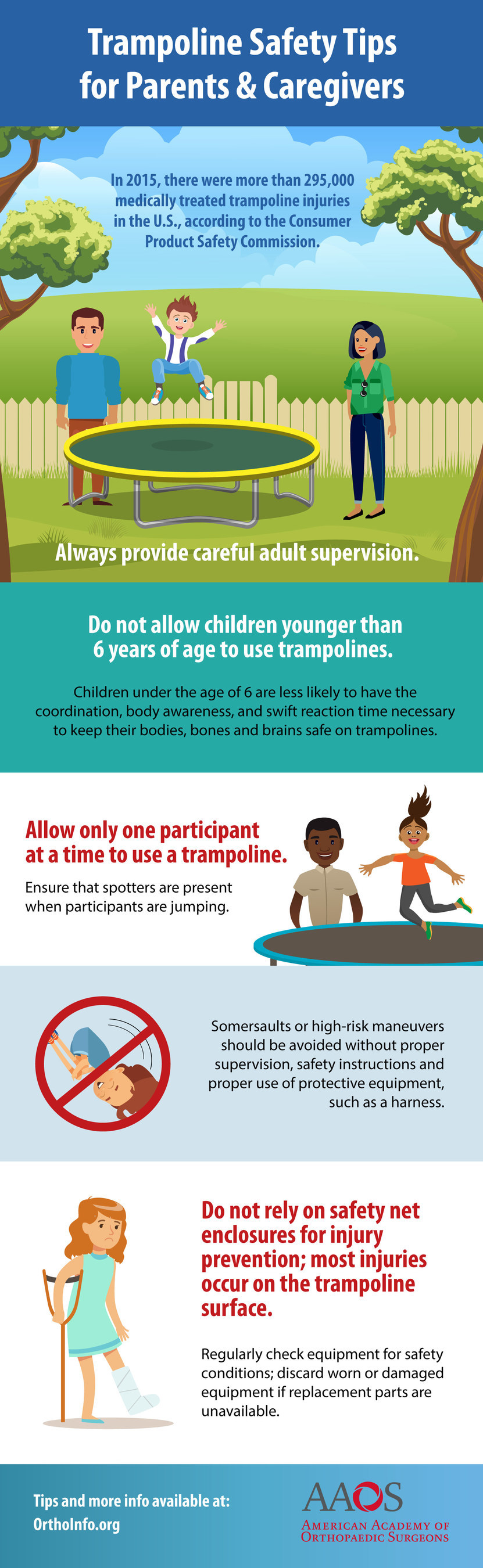
“We want children to enjoy exercise and physical activity, especially during the summer months,” said AAOS spokesperson and Los Angeles pediatric orthopaedic surgeon Jennifer M. Weiss, MD, “but parents and caregivers should know about the dangers of trampolines and the risk for serious injury, especially in very young children. Children younger than age 6 are less likely to have the coordination, body awareness, and swift reaction time necessary to keep their bodies, bones and brains safe on trampolines.”
The dangers of trampoline use were recently highlighted when a 3-year-old Florida boy broke his femur (thigh bone) during routine jumping on a trampoline, requiring a full lower body cast, and causing him tremendous pain and discomfort.
The most common trampoline injuries are sprains and fractures resulting from falls on the trampoline mat, frame or springs; collisions with one or more jumpers; stunts gone wrong; and falls off the trampoline on the ground or other hard surface, according to CPSC.
As highlighted in the American Academy of Orthopaedic Surgeons’ position statement, “Trampolines and trampoline safety,” nearly one-third of trampoline injuries involved fractures; 60 percent of the fractures were located in the upper extremities and approximately 36 percent in the lower extremities. In addition:
Most trampoline injuries occur in the home environment, and more than 90 percent are sustained by children, usually those between the ages of 5 and 14 years. Although most injuries to children occur while they are unsupervised by parents or adults, many also occur when adults are present. More than half of injuries occur on the mat of the trampoline and three-fourths of injuries involve two or more children on the trampoline at the same time.
There is no data that shows a reduction in injury rates for trampolines outfitted with netting and/or other safety equipment.
The American Academy of Orthopaedic Surgeons recommends that parents and caregivers ensure the following to minimize and avoid trampoline injuries:
- Do not allow children younger than 6 years of age to use trampolines.
- Provide careful adult supervision, proper safety measures and instruction when trampolines are used for physical education, competitive gymnastics, diving training, and other similar activities.
- Allow only one participant at a time to use a trampoline.
- Ensure that spotters are present when participants are jumping. Somersaults or high-risk maneuvers should be avoided without proper supervision and instruction; these maneuvers should be attempted only with proper use of protective equipment, such as a harness.
- Place the trampoline-jumping surface at ground level.
- Ensure that supporting bars, strings, and surrounding landing surfaces have adequate protective padding that is in good condition and appropriately placed.
- Regularly check equipment for safety conditions; discard worn or damaged equipment if replacement parts are unavailable
- Do not rely on safety net enclosures for injury prevention; most injuries occur on the trampoline surface.
- Remove trampoline ladders after use to prevent unsupervised access by young children.
More Information about the AAOS
With more than 39,000 members, the American Academy of Orthopaedic Surgeons is the world’s largest medical association of musculoskeletal specialists. The AAOS provides educational programs for orthopaedic surgeons and allied health professionals, champions and advances the highest quality musculoskeletal care for patients, and is the authoritative source of information on bone and joint conditions, treatments and related issues.
Visit AAOS , at:
Newsroom.aaos.org for bone and joint health news, stats, facts, images and interview requests.
ANationinMotion.org for inspirational patient stories, and orthopaedic surgeon tips on maintaining bone and joint health, avoiding injuries, treating musculoskeletal conditions and navigating recovery.
Orthoinfo.org for patient information on hundreds of orthopaedic diseases and conditions.
Facebook.org/AAOS1
Twitter.com/AAOS1
SOURCE American Academy of Orthopaedic Surgeons