
By IMD International, Special for USDR
A major global study – the 3rd annual World Talent Report from IMD business school has identified crisis-riddled Europe as home to nine of the 10 economies best equipped to develop, attract and retain business talent.
The continent as a whole may well be struggling to deal with issues such as sovereign debt, migration, terrorism and the rise of populism and Euro- skepticism.

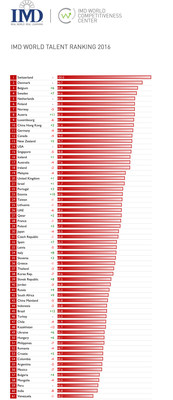
Yet only Hong Kong challenges its hold on the first 10 places in the latest World Talent Ranking, a prestigious annual report by leading global business school IMD.
Switzerland and Denmark still comfortably hold first and second spots, as they did last year, with Belgium rated third, Sweden fourth and the Netherlands fifth.
Finland, Norway, Austria, Luxembourg and Hong Kong complete the top 10, with Germany (11), Iceland (16), Ireland (18) and the UK (20) also featuring in the first 20.
Many prominent economies fare disappointingly, with the US 14th – as it was in 2015 – Japan 30th and mainland China slipping further down the rankings to 43rd.
Professor Arturo Bris, Director of IMD’s World Competitiveness Center, which publishes the report each year, said: “Talent is one of the competitive pillars of Europe.
“It’s true that the region generally continues to face a number of problems, including poor economic growth, declining momentum and negative expectations.
“But the quality of its education systems and its commitment to developing talent from a very young age to retirement should preserve its long-term competitiveness.”
The objective of the World Talent Report is to assess how countries around the globe sustain the talent pool necessary for businesses to maximize their performances.
The research draws on more than two decades’ worth of competitiveness-related data, including an in-depth survey of thousands of executives in the 61 countries studied.
Rankings are aggregated from performance in three overarching categories – investment/development, appeal and readiness – compiled from a wide range of factors.
These include education, apprenticeship, employee training, worker motivation, language skills, cost of living, quality of life, pay, tax rates and brain- drain.
Each country’s evolution in the various aspects is also assessed over the course of the past decade – during which Switzerland has placed first every year.
Professor Bris, an expert in the fields of finance and global competitiveness, said: “The effects of the economic crisis on many parts of Europe can’t be denied.
“Germany, for instance, has been hit hard. Worsening business sentiment and a decline in both the education system and quality of life have seen it fall out of the top 10.
“Yet Northern Europe in particular has generally retained its ‘powerhouse’ reputation and still represents the world’s greatest concentration of business talent hotspots.
“It’s especially striking that nearly every Nordic nation features in the top 10. This is mainly because their education systems feed the economy with the required talent.
“Language barriers and a high cost of living mean these countries aren’t really big attractors of foreign talent, yet they invest public resources in developing the right competencies.
“The opposite situation applies to many Asian countries. They might be amazing attractors of foreign talent, but they don’t invest enough in nurturing local talent.”
Speaking about the talent conditions in the US, Professor Bris added: “The US hasn’t featured in the top 10 since 2008, and we’ve remarked before that economic power and talent don’t necessarily go hand-in-hand.
“Indeed, it’s well worth noting that small can be beautiful when it comes to talent management, as it’s harder for larger countries to adopt and adapt effective systems.
A full breakdown of the IMD World Talent Report 2016 is available at:
http://www.imd.org/uupload/IMD.WebSite/Wcc/NewTalentReport/Talent_2016_web.pdf
This is the third edition of IMD’s World Talent Report. The second, published in 2015, produced a top 10 of Switzerland, Denmark, Luxembourg, Norway, the Netherlands, Finland, Germany, Canada, Belgium and Singapore.
IMD also publishes an annual World Competitiveness Ranking. The 2016 edition’s top 10 consisted of Hong Kong, Switzerland, the US, Singapore, Sweden, Denmark, Ireland, the Netherlands, Norway and Canada. The World Competitiveness Ranking has been published since 1989 and is widely acknowledged as the leading annual report on the competitiveness o f nations.
About IMD
The IMD World Competitiveness Center is a part of IMD business school and also publishes the annual World Competitiveness Yearbook. The IMD World Competitiveness Yearbook has been published since 1989 and is widely acknowledged as the leading annual report on the competitiveness of countries.
SOURCE IMD International